Demand for Montessori-inspired toys is growing, but a popular product is not automatically a good purchase. Parents and educators often look for open-ended materials that invite children to sort, stack, pour, and practice everyday skills. That helps explain why are montessori toys becoming popular: many families value hands-on play, simple designs, and child-led learning. A wooden knob puzzle on a classroom shelf may look uncomplicated. Its finish, fit, durability, and age suitability still deserve careful attention.
For buyers sourcing in 2026, the challenge is finding suppliers who can deliver consistent quality as demand rises. Ask for clear material specifications, product samples, age recommendations, and quality-control records. Check that product claims match what the toy actually supports; “educational” is not a substitute for evidence. Ask how the supplier handles defects, changing lead times, and repeat orders. Small test orders can reveal loose fittings, rough edges, or packaging that fails during shipping. Details matter.
There is no perfect supplier. A polished catalog can hide uneven production, while a modest workshop may communicate clearly and stand behind its work. That uncertainty is worth acknowledging. Compare suppliers using the same criteria, document sample results, and verify applicable safety requirements for your target market before ordering. A thoughtful sourcing process protects children, supports reliable inventory, and gives buyers a stronger basis for choosing toys that genuinely suit Montessori-inspired settings.
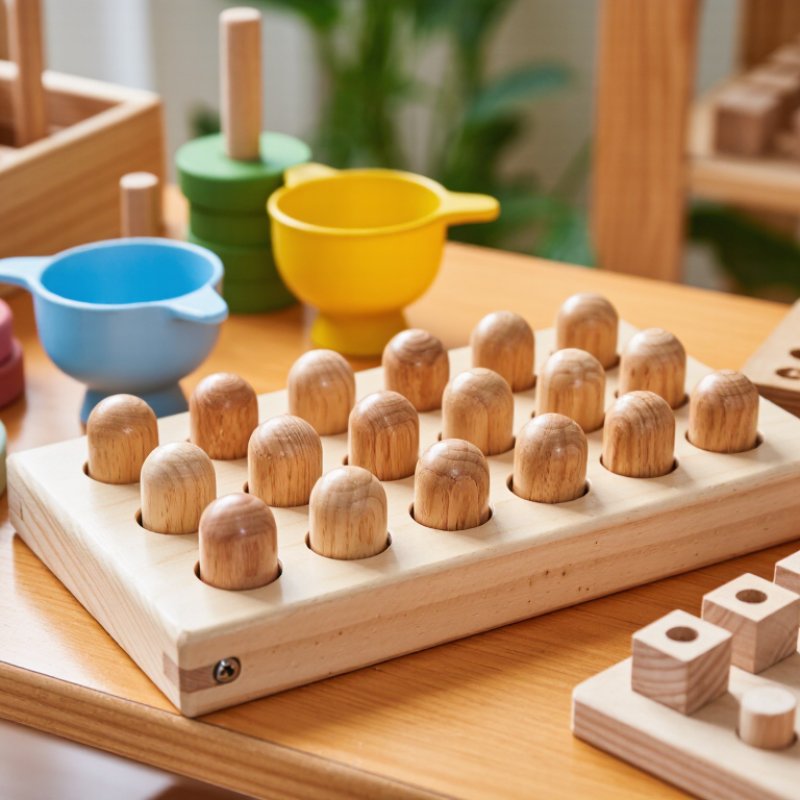
Define “Montessori” through observable features, not a label. Look for toys that invite a child to act independently: a wooden shape sorter with one clear task, a dressing frame with sturdy fasteners, or graded cylinders that make errors visible. Check age suitability, smooth edges, finish quality, replacement-part availability, and packaging durability. Ask suppliers for material specifications, product test documentation, and sample units. Then test samples with children and caregivers in realistic settings. A beautiful sample can still wear poorly.
Sourcing goals should be measurable: target landed cost, minimum order quantity, production lead time, defect tolerance, and reorder capacity. Grand View Research estimated the global educational toys market at about USD 65.4 billion in 2023, with projected growth through 2030. That broad category is not a forecast for Montessori products, but it signals expanding interest in learning-led play. Treat projections as context, not proof of demand. Your own age-group research and small pilot orders matter more. Some criteria will need revision after use.
Tips: Request a batch sample, not only a showroom piece. Inspect a bead’s finish, pull on a handle, and record defects. Compare supplier claims with documents and hands-on checks. Small orders cost more per unit, but they can reveal problems early.
How to Source Montessori Toys in 2026 as Demand Grows
Assessing 2026 demand starts with local signals, not broad claims. Ask childcare centers and independent retailers which materials families request, and track repeat orders by season. Practical life tools, stacking blocks, and tactile sorting sets suit different learning stages. Demand may grow, but it will not rise evenly. Not everywhere.
For infants and toddlers, prioritize large, easy-to-grip pieces with smooth edges and simple forms. Preschoolers often need more challenging puzzles, counting beads, and child-sized tools. Older children may benefit from open-ended building materials and activities that encourage planning. Check recommended ages and test samples for finish quality, durability, and clear instructions before placing larger orders. A low unit price can hide costly breakage.
Regional needs also shape purchasing. In dense urban areas, compact sets and space-saving storage may matter more. Rural buyers may value durable, versatile kits that serve mixed-age groups. Warm, humid climates can affect wood and packaging, so request material details and storage guidance. Ask suppliers for consistent specifications and realistic lead times. A regional trend is only a starting point; local feedback can prove it wrong. I would review sales and returns quarterly, then adjust the mix rather than commit to one forecast.
Montessori developmental planes provide a practical framework for organizing products by age. The chart shows the length of each conventional age band—not sales, market size, or demand.
Planning note: Commonly described Montessori planes are birth–3, 3–6, and 6–12 years. These age bands can guide assortment planning, but they are not evidence of purchasing demand. Publicly comparable regional data on Montessori-toy demand is limited; validate local age mix, safety requirements, materials preferences, and retailer feedback before sourcing.
As demand grows, supplier selection matters as much as product design. Grand View Research estimated the global toys market at USD 108.7 billion in 2023, with continued growth projected through 2030. That broad market figure does not prove Montessori toys are growing at the same rate. Treat it as context, not a sales forecast.
Compare manufacturers and wholesalers using the same scorecard. Ask for factory details, minimum order quantities, lead times, and written quality-control steps. Request sample pieces, then inspect edges, finish, material consistency, and small-part construction. Ask for current safety-test reports relevant to your target markets, plus batch traceability. Evidence matters. A polished sample proves little if bulk production uses different wood or coatings. Check how suppliers handle defects, replacement stock, and production delays. Then test again.
Circana and The Toy Association reported that U.S. toy sales fell 8% in 2023, to USD 40.2 billion. That uneven picture makes cautious purchasing useful: compare landed costs, not unit prices alone, and avoid oversized first orders. For wooden materials, ask about moisture control and storage; warping can appear after shipment. A supplier may answer every question quickly, yet still lack consistent records. That is worth questioning. Keep comparison notes, verify claims independently, and reassess after each production run.
| Supplier type | Best fit | Customization and control | Order and lead-time considerations | Qualification checks | Main trade-off |
|---|---|---|---|---|---|
| Direct manufacturer (OEM) | Buyers with defined specifications, repeat demand, or a need for private-label production. | Can offer more control over materials, dimensions, finishes, packaging, and production specifications; confirm what is actually available. | Minimum order quantities and production schedules are factory-specific. Request written quotations for tooling, samples, production, and shipping separately. | Verify the legal entity and factory address, production capability, subcontracting policy, quality controls, and product-specific test documentation. | Greater coordination and product-development responsibility may be required from the buyer. |
| Design-led manufacturer (ODM) | Buyers seeking an existing design that can be adapted, such as through packaging, color, or selected material options. | Usually starts from the supplier’s existing design; confirm customization limits, design ownership, and exclusivity in writing. | Existing designs may avoid some development steps, but stock availability, customization, and order thresholds vary by supplier. | Request a sample matching the proposed production specification, material details, test reports, and written confirmation of permitted design changes. | The design may also be offered to other buyers unless contractual terms provide otherwise. |
| Wholesale distributor | Retailers testing demand, buying assorted products, or replenishing smaller quantities from available inventory. | Typically limited to the distributor’s listed assortment and available packaging options. | Ask for current stock status, case-pack quantity, reorder terms, dispatch location, and delivery estimates; these vary by distributor and item. | Identify the original manufacturer or responsible importer and obtain compliance records that correspond to the exact product and model. | Less control over design and production; documentation may require follow-up through the supply chain. |
| Domestic importer or wholesaler | Buyers who prefer purchasing through a local business and want to clarify domestic delivery, returns, and support arrangements. | Usually offers established products rather than factory-level product changes; confirm availability directly. | Domestic stock can simplify replenishment, but inventory, shipping terms, and return policies must be confirmed for each order. | Confirm the importer’s role, product traceability, applicable-market compliance records, warranty terms, and recall-contact process. | The importer may not control the original product design or factory processes. |
| Made-to-order workshop | Small runs or specialized wooden learning materials where direct communication about construction is important. | May support specific dimensions or finishes, subject to equipment, materials, and documented production capacity. | Capacity and completion times can vary. Agree on a sample, production quantity, inspection points, and delivery schedule before placing an order. | Review material specifications, finish and coating information, age grading, small-part risks, and applicable testing for the finished item. | A small production operation may have limited capacity or less standardized documentation; verify both rather than assuming. |
| Check | What to request or verify | Why it matters |
|---|---|---|
| Product identity and traceability | Model or SKU, intended age range, bill of materials, factory or responsible business details, batch identification, and change-notification process. | Helps connect samples, test records, production goods, and any later safety or quality issue. |
| U.S. children’s product requirements | For products subject to applicable U.S. rules, request the Children’s Product Certificate and supporting test reports from a CPSC-accepted third-party laboratory. Check tracking-label requirements and applicable rules for the specific product. | The U.S. Consumer Product Safety Commission identifies applicable children’s product testing and certification obligations; requirements depend on product type and use. |
| Lead and phthalates (U.S.) | For applicable children’s products, verify lead limits of 100 ppm in accessible substrate materials and 90 ppm in paint or similar surface coatings. For regulated children’s toys and child-care articles, check the 0.1% limit for each of the eight restricted phthalates in accessible components. | These are U.S. statutory limits for covered products and materials; applicability and testing details should be confirmed for the exact item. |
| EU toy requirements | For toys placed on the EU market, confirm applicable Toy Safety Directive 2009/48/EC obligations, conformity assessment, technical documentation, Declaration of Conformity, and CE marking. Check relevant EN 71 requirements for the product. | EU toy compliance covers safety and conformity obligations; the applicable standards and assessment route depend on the product. |
| Wood, coatings, and material claims | Request wood species or material specifications, coating details, and evidence for any environmental or certified-wood claim. For a forest-certification claim, verify the relevant certificate and chain-of-custody scope. | Material and finish affect product consistency and safety review; certification claims should be supported by records that cover the product and supply chain. |
| Sample and production consistency | Approve a reference sample and written specifications. Define inspection criteria for dimensions, finish, assembly, packaging, and labeling; confirm how material or process changes are controlled. | A sample is not a substitute for checking that production goods match the approved specification and applicable compliance records. |
| Commercial terms and landed cost | Compare unit price, minimum order, tooling or setup fees, sample charges, packaging, freight, insurance, duties, payment terms, lead time, and defect remedies. | Quoted unit price alone does not show the total cost or the buyer’s obligations. Terms and estimates should be confirmed in writing. |
Note: Montessori is an educational approach, not a toy-safety certification. Verify product claims, age grading, and current regulatory requirements for the destination market before ordering; standards and obligations may change.
As demand for Montessori toys grows, sourcing should begin with evidence, not attractive product photos. Ask suppliers which safety standards apply to your target market and the toy’s stated age range. Request recent test reports for the exact product, including its coatings, small parts, and construction. Check that the report identifies the testing laboratory and model number. A certificate alone is not enough. Its scope may exclude the item you plan to buy.
Look closely at materials. A smooth beechwood block should have sealed edges, consistent grain, and no sharp splinters; ask how wood finishes and dyes are tested. For certified materials, verify the certificate number and supply-chain coverage rather than relying on a logo.
Then examine ethical practices: request factory locations, subcontractor details, and evidence of worker-safety checks. Ask how concerns are handled, not just whether an audit occurred. This takes time. Records can still leave gaps, and I would not treat a polished document as proof of a perfect process. Compare answers across suppliers, keep dated copies, and follow up when details about batches, wages, or sourcing remain vague.
A reliable plan starts with suppliers, not product photos. Request factory details, material specifications, safety test reports, and production capacity before negotiating prices. Order samples from at least two factories. Inspect smooth edges, loose parts, paint coverage, and surface splinters by hand. Small defects become expensive returns.
Build a purchasing sheet with target costs, minimum order quantities, lead times, and reorder points. Confirm whether prices include packaging, inspections, and transport. Written specifications should state wood type, dimensions, color limits, and age guidance. Keep one approved sample in your office. It becomes the reference during mass production. Our first demand forecast was too optimistic, so smaller trial orders would have reduced excess stock.
Quality control needs several checkpoints. Review the first production batch, inspect random cartons before shipment, and photograph every defect. Test package strength with controlled drop checks. Keep batch codes and supplier records for traceability. Independent laboratory verification may be necessary for the destination market. Never accept vague compliance claims.
Logistics planning should include carton measurements, total weight, port timing, customs documents, and warehouse capacity. Add buffer time around holidays and weather disruptions. Use two qualified suppliers for essential products when possible. A low shipping quote can hide weak packaging or costly delays. Recheck landed costs monthly. Demand may grow, but rushed purchasing creates avoidable risk.
Look for one clear task and visible feedback. A shape sorter or graded cylinder set can support independent practice. The label alone proves little.
Check smooth edges, firm handles, even finishes, and strong fasteners. Pull the parts gently. Record every defect.
A showroom piece may not match bulk production. Batch samples reveal changes in wood, coating, or assembly. Samples cost more, but mistakes appear earlier.
Compare minimum orders, lead times, landed costs, defect policies, and replacement stock. Ask for written quality-control procedures. Fast replies are not enough.
Request recent reports for the exact product and age range. Check the laboratory, model number, materials, and tested coatings. A certificate can have limited scope.
Inspect sealed edges, consistent wood grain, and smooth surfaces. Ask how finishes and dyes are tested. Warping may appear after shipping.
Ask for factory locations, subcontractor details, and worker-safety records. Check how concerns are handled. A polished audit does not prove perfect conditions.
Start with a small pilot order and test it with caregivers and children. Compare real use with supplier claims. Some criteria will need revision.
Sourcing Montessori toys in 2026 starts with defining what makes a toy purposeful: simple design, hands-on learning, age-appropriate challenge, and durable, child-safe materials. Buyers should set clear goals for price, quality, and target customers, then assess demand by age group and region. Understanding why are montessori toys becoming popular can help suppliers respond to growing interest in toys that encourage independence, practical skills, and open-ended play.
Next, compare qualified manufacturers and wholesale suppliers based on product consistency, communication, and production capacity. Verify material specifications, relevant safety documentation, and responsible manufacturing practices before placing an order. A dependable purchasing plan should include sample testing, written quality standards, inspection checkpoints, realistic lead times, and logistics contingencies. With these steps, businesses can build a more reliable supply chain and offer Montessori-inspired toys that meet customer expectations as demand grows.

Bully Toy